MANILA, Philippines — President Lee Jae Myung on Monday pledged to expand South Korea's cooperation with five Mekong nations into new areas, including combating transnational crime and strengthening critical mineral supply chains.
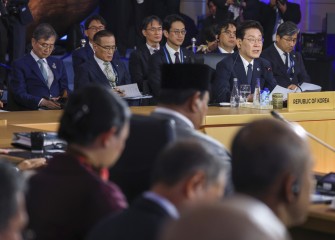
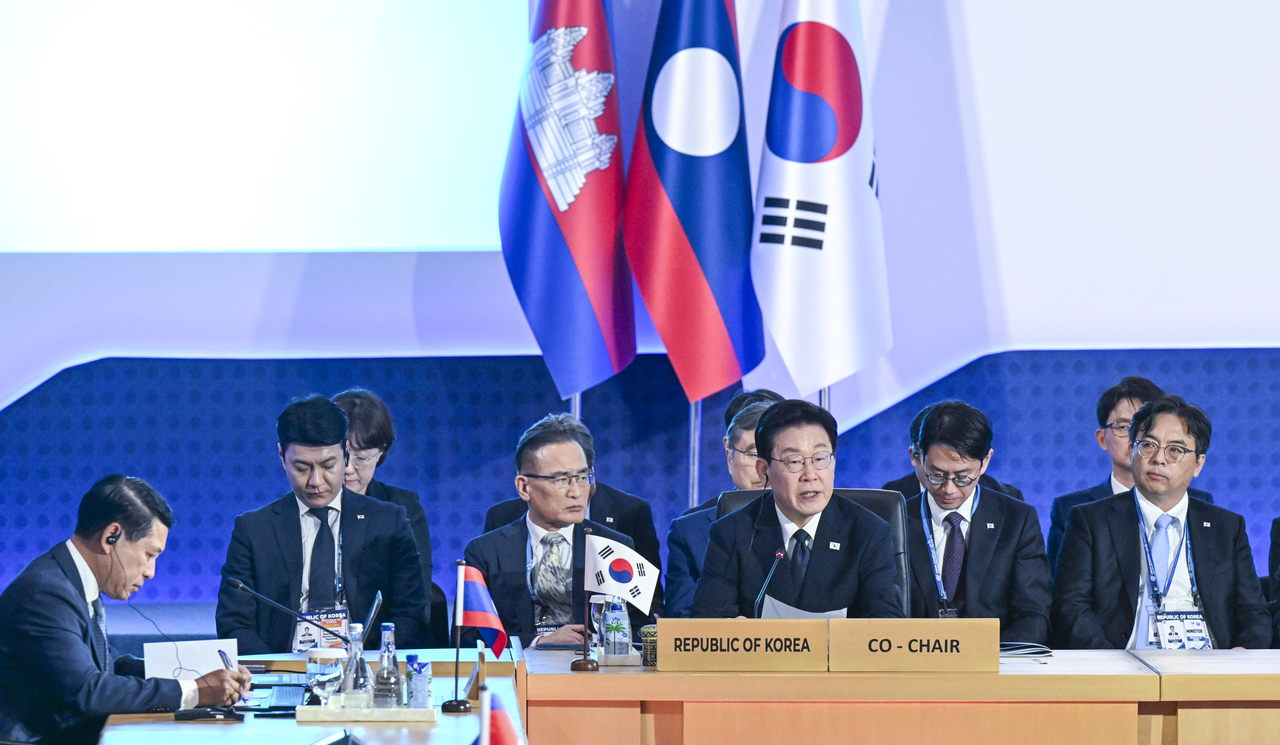
Lee co-chaired the Korea-Mekong summit with Thai Prime Minister Anutin Charnvirakul, bringing together South Korea and five countries in the Mekong River basin — Cambodia, Laos, Myanmar, Thailand and Vietnam — for the first such gathering since 2020.
The summit, held on the sidelines of the ASEAN-related meetings in Manila, the Philippines, also marked the 15th anniversary of Korea-Mekong cooperation, which began with foreign minister-level talks in 2011 before being elevated to the leaders' level in 2019.
The two sides upgraded their relationship to a strategic partnership at their second summit in 2020. However, no summit had been held since, against the backdrop of Myanmar's political crisis following the 2021 military coup.
“Even though the summit was temporarily suspended, our cooperation did not stop,” Lee said in his opening remarks.
Lee pointed to the continued operation of the Korea-Mekong Cooperation Fund and the resumption of foreign ministers' meetings in 2024 as evidence of the partnership's resilience.
“I believe the past six years have been a time for Korea and the Mekong countries to reaffirm each other's importance and further strengthen our cooperative relationship,” he said.
Invoking a Korean proverb that says, “The ground becomes firmer after rain,” Lee described the summit's return as an opportunity to deepen the strategic partnership.
“Today's summit will mark an important turning point in taking the Korea-Mekong strategic partnership to the next level,” he said.
Lee emphasized expanding cooperation into new areas, including combating transnational crime and strengthening critical mineral supply chains.
“We will further expand the scope of our cooperation into new areas, including responding to transnational crime and critical mineral supply chains,” he said.
The push comes as Southeast Asia grapples with cross-border criminal networks involved in online scams, human trafficking and other illicit activities. Thailand has previously identified telecom fraud, human trafficking and narcotics as priorities for security cooperation with South Korea.
Critical minerals have also emerged as a strategic concern, as governments and manufacturers seek to diversify access to raw materials needed for batteries, electric vehicles and other advanced technologies.
Lee also presented South Korea's economic development experience and technological capabilities as assets it could share with the Mekong countries.
“The Republic of Korea has overcome poverty through industrialization and moved beyond the middle-income trap to become an advanced economy,” Lee said. referring to South Korea by its official name.
“We now intend to share with the Mekong countries the experience and capabilities that have enabled the Republic of Korea to grow from an aid recipient into an aid donor,” he added.
Lee pointed to South Korea's capabilities in artificial intelligence and digital technology, manufacturing networks established in the Mekong region and strong people-to-people ties through multicultural families, workers and international students as foundations for shared growth.
“The Republic of Korea is the ideal partner to accompany the Mekong countries on their development journey,” he said.
Lee also pledged to help the Mekong countries realize their economic potential under his ASEAN-ROK Comprehensive Strategic Partnership Vision, while strengthening practical, mutually beneficial cooperation across seven priority areas.
The areas cover culture and tourism, human resources development, agriculture and rural development, infrastructure, information and communications technology, the environment and nontraditional security challenges.
South Korea and ASEAN elevated their relationship to a Comprehensive Strategic Partnership in October 2024. At last year's Korea-ASEAN summit, Lee unveiled his CSP Vision, built around three goals — contributor, springboard and partner — aimed at expanding people-to-people exchanges, economic cooperation and regional security ties.
In his opening remarks, Charnvirakul similarly emphasized the need to reinvigorate the partnership amid shifting regional and global challenges.
“This summit provides an important opportunity to renew our commitment, sharpen our strategic focus and chart a forward-looking course for the Mekong-Korea partnership for the years ahead,” Charnvirakul said.
Charnvirakul pointed to the progress made since the 2011 Han River Declaration, which laid the foundation for cooperation between South Korea and the five Mekong countries.
“Since the Han River Declaration 15 years ago, our partnership has grown into a meaningful platform for practical cooperation built on our three pillars of people, prosperity and peace and underpinned by mutual trust,” he said.
“This task becomes more important as geopolitical and geoeconomic uncertainties reshape our region and the world.”
dagyumji@heraldcorp.com